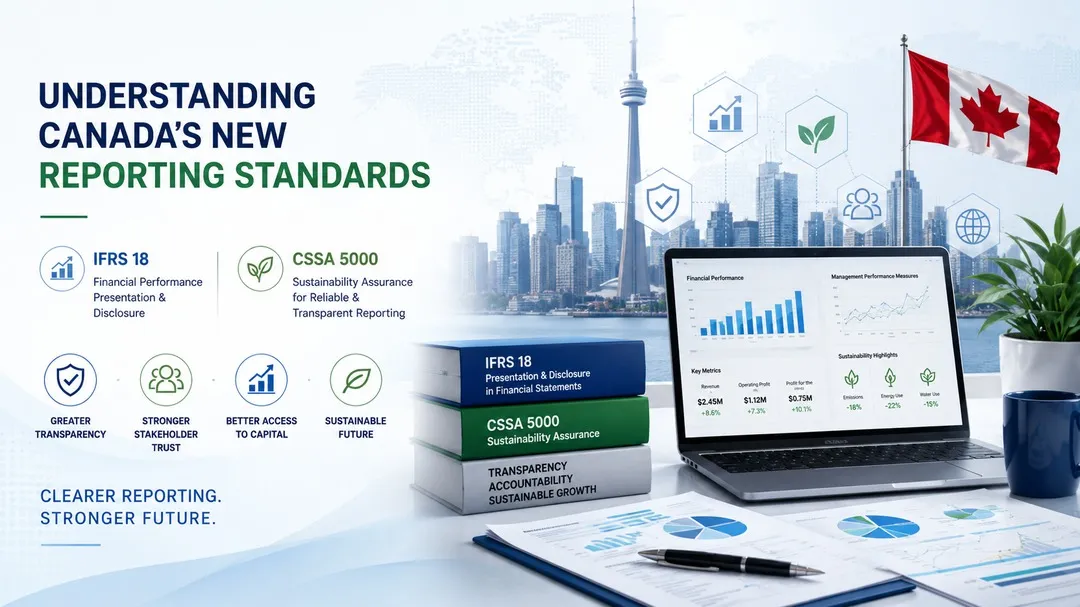
IFRS 18 and Sustainability Assurance (CSSA 5000)
Mid-2026 is a practical turning point for Canadian finance teams—not because everything becomes mandatory overnight, but because two major frameworks are now final, increasingly referenced by stakeholders, and approaching effective dates.
1) What is IFRS 18 and who does it affect?
For entrepreneurs and corporations, these changes are not just technical. They can influence banking conversations, investor confidence, valuation discussions, governance expectations, and compliance readiness.
Who is impacted in Canada?
IFRS 18 – Presentation and Disclosure in Financial Statements is a new IFRS Accounting Standard that updates how companies present financial performance—especially the statement of profit or loss (income statement) and certain disclosures. It aims to improve comparability by standardizing key subtotals and clarifying how items should be grouped and explained.
Key IFRS 18 changes in plain language
IFRS 18 is effective for annual reporting periods beginning on or after January 1, 2027, with early adoption permitted. June 2026 matters because it is the window to test reporting changes, validate comparatives, and align internal reporting before mandatory application.
Timing
As sustainability reporting expands (including GHG emissions, climate risks, social metrics, and governance practices), stakeholders increasingly ask: “Can we trust the numbers?” Assurance addresses that question by providing an independent conclusion over sustainability information.
2) Sustainability Assurance in Canada: CSSA 5000
CSSA 5000 (Canadian Standard on Sustainability Assurance) is Canada’s sustainability assurance standard aligned with the international baseline ISSA 5000. It sets overarching requirements for how assurance practitioners plan, perform, and report on sustainability assurance engagements across different frameworks and topics.
Why assurance standards matter—even for private businesses
Even if you are not publicly listed, sustainability data is increasingly used in:
When does it take effect?
Canada’s CSSA 5000 implementation follows the global baseline, ISSA 5000, and is expected to be applied to sustainability assurance engagements in line with the standard’s effective-date guidance. For many organizations, the right way to interpret the timeline is simple: if you plan to publish sustainability metrics and expect third-party assurance, start building systems, controls, and documentation well in advance.
Lenders and investors care about consistent performance reporting. IFRS 18 can change presentation and subtotals, which may influence covenant conversations or performance narratives—even if cash flows are unchanged. Early preparation reduces surprises.
Sustainability claims without strong support can create reputational risk. Assurance performed under a recognized standard helps demonstrate that disclosures are reliable and decision-useful.
Even when not strictly mandatory, these frameworks shape market expectations. Being prepared reduces the risk of rushed reporting, inconsistent metrics, and stakeholder distrust.
Treat mid-2026 as a readiness checkpoint. A practical approach:
June 2026 is less about a sudden compliance cliff and more about getting ahead of the curve. IFRS 18 becomes mandatory for IFRS reporters starting in 2027, and Canada’s sustainability assurance framework is now established and converging with global practice. For Canadian businesses, the opportunity is straightforward: better reporting builds trust. Organizations that prepare early can improve transparency, strengthen lender and investor confidence, and position themselves as credible, future-ready operators.